
NOCCCD 2021-2030 Educational and Facilities Master Plan
Includes information on the Educational and Facilities Master Plan (EFMP) and the subsequent EFMP Refresh. Developed collaboratively between all three campus communities serving as one, the purpose of this document is to provide updated and refreshed guidance for the District through 2030 and serve as the measuring stick by which future educational programs and facilities investments will be evaluated.
Jump to Related FilesThe EFMP is grounded in internal realities, such as the current systems and programs, and integrates external influences, such as demographic trends and the community’s educational interests and workforce needs.
The EFMP is comprised of two parts: The primary driver is the Educational Master Plan (EMP), and its directions and needs are supported by the Facilities Master Plan (FMP). Combined, these elements create a ten-year roadmap for NOCCCD, which will guide planning efforts, strategic plans, program reviews, and allocation of resources.
Though guided by planners and architects, the Master Plan is, at its core, a District, campus, and community effort. A successful plan combines critical input from students, faculty, staff, administrators, and community members, and all of these groups have been intrinsically involved in this document’s creation.
As such, within the EFMP, any reference to the District represents the campus communities of Cypress College, Fullerton College, North Orange Continuing Education, and District Services. This includes students, faculty, staff, and administrators.
Purpose of the EFMP Refresh
Developed collaboratively between all three campus communities serving as one, the purpose of this document is to provide updated and refreshed guidance for the District through 2030 and serve as the measuring stick by which future educational programs and facilities investments will be evaluated.
The 2020 Educational and Facilities Master Plan was originally crafted during the onset of a global pandemic, at a time when the world faced unprecedented uncertainties. The prevailing conditions at that time were marked by disruptions in learning, abrupt transitions to remote and hybrid instruction modalities, and an acute awareness of the need for adaptable facilities to accommodate health and safety measures. In drafting the plan, the original project team aimed to address immediate needs and chart a course forward in a time of uncertainty.
Today, the District stands at a critical juncture, requiring a refresh to this document that will reprioritize the District’s planning of near-term and future decisions by reaffirming and reallocating current and future projects through 2030.
As we embark on this refresh, it is essential to remember the vision and core values of the original EFMP are not changing, but rather being reprioritized to guide the District towards these initiatives and ensure the plan is responsive to current educational and societal needs. We must reassess whether our educational programs, services, and facilities continue to meet the diverse needs of our students, educators, and the community, both on campus and remotely. This process has entailed engaging students, faculty, and staff across all three campuses, reviewing emerging workforce trends, evaluating the utilization and effectiveness of existing facilities, and considering sustainability, accessibility and equity as paramount factors.
The purpose of the Refresh is also to inform subsequent project-specific efforts in physical planning; program validation, feasibility, and test-fit planning. As such, it defines a framework, within which individual projects, both renovation and new construction, can be realized as part of a larger network of campus assets and infrastructure.
A critical outgrowth of the EFMP Refresh is the potential reallocation of Measure J project funding to address current prioritized needs. Given the dramatic changes in how higher education is delivered and accessed in a post-COVID environment, the Refresh highlights current and future needs based upon rapidly evolving conditions, including a shift to remote and hybrid instruction modalities that have left some classrooms vacant. Ultimately, this Refresh aims to update and recenter the District as it steers its course following such unprecedented times, and heads to a new and brighter tomorrow.
Executive Summary
The COVID-19 pandemic reshaped much of the world and created long-lasting ripple effects that have shifted some of the very basic needs of students, faculty, and staff within the District. As we continue to evaluate these shifts, it is important to reflect on the progress made and the experiences gained over the past three years.
We additionally recognize that as our educational, physical facility, and virtual needs continue to evolve, so should our campus assets. Ease of access to resources became a key challenge, as students, faculty, and staff simultaneously navigate on-ground and virtual networks. The increasingly hybrid nature of campus experiences requires institutional leadership that is agile and responsive to change.
The Refresh helps to address these challenges in a post-pandemic environment that has reshaped and accelerated the transformation of our educational environment. The integration of new technologies is integral to teaching and learning, and the demand for flexible, adaptable spaces has taken on a new significance. Additionally, the social and emotional well-being of our students and the broader community now stand as critical priorities in education.
Several modifications were implemented to enhance the original EFMP. First, the educational themes were recategorized to better reflect the District’s goals and provide implementable guidance across all six themes. Where the original EFMP spoke to “Online Learning”, there is an understanding that educational modalities have moved away from a binary “in-person” or “online” towards more flexible and technology-rich learning environments. Through various campus engagements, it was apparent that student success is directly impacted by their experience on campus and cannot be viewed independently of each other. Spaces that welcome students and enhance their sense of belonging are more important than ever. The EFMP refresh merges student experience with success for a holistic approach towards the District’s goals.
Furthermore, the EFMP refresh incorporated a crucial focus on diversity, equity, inclusion, anti-racism, and accessibility, emphasizing the importance of creating an inclusive and equitable educational environment and should be used as a lens throughout all themes. A notable addition is an integration of Sustainability, recognizing the significance of being good stewards of environmental, human, and societal resources.
Project Priorities
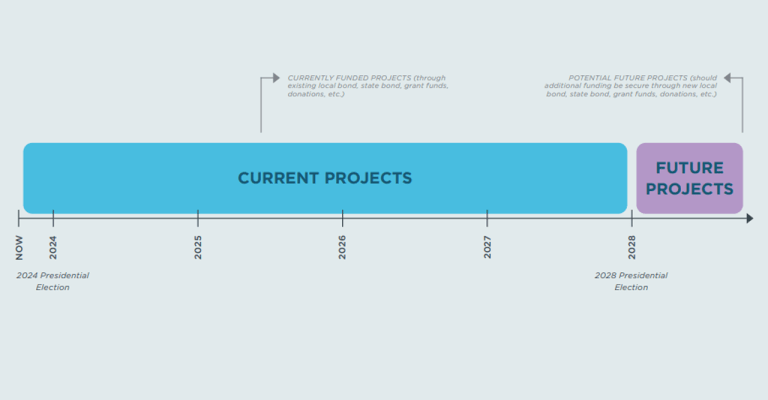
Currently funded projects, through existing local bond, state bond, grant funds, donations, and other sources, will continue until 2028, the same year as the 2028 Presidential Election. Potential future projects will be considered after 2028, should additional funding be secured through new local bond, state bond, grant funds, donations, and other similar sources.
Methodologies
The 2023 EFMP Refresh is meant to serve as an update. As part of the overall planning process, the EFMP acknowledges and incorporates prior educational and facilities planning documents to ensure that the 2023 EFMP Refresh aligns with past and ongoing
efforts. The EFMP also utilized key research and data metrics from national and regional resources, such as the United States Census, the California Chancellor’s Office, Orange County Business Council, Orange County Centers of Excellence for Labor Market Research report, and other third-party labor market reports.
Campus Engagement
Similar to the original EFMP process, the planning team spent considerable time and made conscious efforts to involve stakeholders from all campuses. The planning team was guided by a District-wide Steering Committee, made up of 30-plus members representing campuses and stakeholders.
The committee met a total of nine times over a four-month span to discuss the impact of the COVID-19 pandemic and its effects on education and the utilization of spaces, to update the Strategic Directions and Goals, to discuss the participation and feedback from campus forums, and to review and provide input to the educational and facilities components of the plan.
In addition, reviews and recommendations were given by the Steering Committee and campus stakeholders for refinement of the EFMP, prior to its review by the District Consultation Council and Board of Trustees.
The consultant team spent a significant amount of time engaging the campus community through forums and stakeholder meetings with students, faculty, classified staff, and campus and District administrators. The team utilized a variety of interactive and engaging activities to bolster participation and solicit insightful information. These activities provided direct feedback on how spaces through each campus were currently being used and gave context to how to repurpose and better use spaces to better the student, faculty, and staff experience.
Data Integration
The EFMP Refresh process identified new tools and studies that can be used by the District to better inform future decision-making processes, by measuring the optimization and utilization of campus resources. Notably, two pivotal studies from the district played a crucial role in shaping this evolution: the 2023 Cambridge West space inventory report and the real-time data from the Dabblefox platform for space utilization.
These studies, with feedback gathered during the engagement process, have provided both quantitative and qualitative feedback to form a solid foundation for understanding and addressing emerging needs. We strongly believe that these studies and methods should be further developed and expanded upon by the District.
2023 Cambridge West Report
The Cambridge West report examines the District-wide space inventory using data from the District’s Fusion database and provides an analysis of “what the District has”. Extracting square footages and room types for all rooms across the District, the report provided insights into the composition of space at each campus. It highlighted hierarchies in the distribution of room types, offering valuable information on the macro scale of each building’s contents. This data has proven to be essential for understanding the
room type uses on each campus.
Dabblefox Data
The Cambridge West report was a study of “what the District has,” the live data from the emerging Dabblefox platform provided information on “how the District uses it”. Similar to the Cambridge West report, it analyzed each room across the district but cross-referenced them in real-time with the academic course calendar to gauge the frequency of use. Utilization rates were expressed through a capacity/load ratio, where percentages much larger than 100% are indicative of low utilization. On a macro scale, considering the weighted average of these capacity/load ratios can pinpoint underutilized buildings, marking them as potential candidates for programmatic reconsideration to enhance overall campus utilization. While the Dabblefox data is not complete for all campuses, completing the data analysis for all three campuses should be a top District-wide priority.
Preparation for the Plan
The EFMP planning process is an investment in advancing our collective vision to create a welcoming learning environment in support of student success. The planning process also informs critical decision making to ensure that our efforts are aligned with State initiatives, such as Vision for Success, Guided Pathways, and the new Student Centered Funding Formula. It is an opportunity to build consensus among students, faculty, staff, and management to reimagine and refresh our approach to educational and facilities planning.
Though guided by planners, architects and consulting experts, the EFMP is, at its core, a District, campus, and community effort. A successful plan is only built with critical input from students, faculty, staff, administrators, and community members.
In summer of 2019, NOCCCD began collecting information through surveys, community meetings, and internal analysis to guide the original EFMP.
| Period | Activities |
|---|---|
| June – August 2019 |
|
| September – November 2019 |
|
| December 2019 – February 2020 |
|
| March – May 2020 |
|
The District, along with lead consultant Brailsford & Dunlavey and architect group Moore Ruble Yudell Architects & Planners, met with constituents across the District to gather input on the Comprehensive EFMP. Below is a list of constituent groups involved in the CMP planning process.
Cypress College Constituent Groups
- Academic Senate
- President's Advisory Council
- President's Cabinet
- Associated Students
- Diversity, Equity & Inclusion
- President's Cabinet (2nd Visit)
- Guided Pathways Committee
- Curriculum Committee
- Faculty Senate (2nd Visit)
- Program Review Committee
Fullerton College Constituent Groups
- Faculty Senate
- President's Advisory Council
- President's Staff
- Facilities Team Meeting
- Student Equity Workgroup
- Guided Pathways Committee
- President's Advisory Council (2nd Visit)
- Fullerton Classified Senate
- Diversity Committee
- Curriculum Committee
- Program Review Committee
- Associated Students
- Disability Support Services
NOCE
- Academic Senate
- Provost's Cabinet
- Management Team
- Adjunct Faculty Training
- CAEP
- Management Team
- Faculty Senate
- Curriculum Committee
- Disability Support Services
- Open Forum
District-wide
- Manager's Retreat
- District Consultation Council
- Measure J Facilities Team Meeting
- Board of Trustees
- Educational Services & Institutional Effectiveness
- Strategic Asset Value Sessions
- Open Forums
- Steering Committee Meetings
- District Consultation Council
- Board of Trustees
Steering Committee
The EFMP Steering Committee will guide the District-wide development, review and vetting of the Plan, including analysis of data and input, as well as the discussion of key findings and recommendations. The recommendations will be presented to the appropriate governance committees; campus staff, students and administration; community members; District administration; and the NOCCCD Board of Trustees. The Board of Trustees will vote on the final draft of the 2021-2030 EFMP before implementation.
Purpose
The EFMP Steering Committee's purpose is to serve as a District-wide recommending body for the planning process. The committee is tasked with overseeing the assessment of the external and internal environment at Cypress College, Fullerton College, North Orange Continuing Education and District Services. The committee provides recommendations on instructional and support programs, technology, facilities, and recommendations for future plans that meet the changing needs of students and the communities served by the District.
Functions
During the planning process, committee members will provide oversight on the scope of work, timeline and recommendations to and from Brailsford & Dunlavey with Moore Ruble Yudell Architects and Planners.
The EFMP Steering Committee will:
- Meet once (1) a month for 2 hours from September 2019 through April 30, 2020 or Final Presentation to the Board of Trustees, whichever comes first
- Guide and, when necessary, assist the consultants with information gathering, oversight of the timeline and work plan for the four entities: Cypress College, Fullerton College, North Orange Continuing Education, and District Services
- Assist in formulating pertinent questions, themes and priorities in preparation for District-wide and community engagement from all identified constituents
Priorities include but are not limited to:
- Visioning and strategic analysis
- Data gathering and analysis
- Analysis of current and future demographic and economic data
- Developing new District-wide Strategic Directions
- Discuss and resolve problems, concerns, and/or issues regarding the planning process
Committee members will make all attempts to talk openly about concerns until consensus is achieved and communicated to consultants and leadership.
The following presentations were made to the Steering Committee.
| Date | Presentation |
|---|---|
| July 17, 2019 | Cypress College Vision Discussion |
| September 12, 2019 | Academic Senate Presentation |
| September 16, 2019 | Associated Students Presentation |
| November 13, 2019 | Diversity, Equity & Inclusion Presentation |
| November 14, 2019 | President's Advisory Council Presentation |
| November 19, 2019 | Curriculum Committee Presentation |
| December 2, 2019 | Deans Presentation |
| Date | Presentation |
|---|---|
| August 5, 2019 | Fullerton College Vision Discussion |
| September 5, 2019 | Faculty Senate Presentation |
| September 11, 2019 | President's Advisory Council Presentation |
| October 8, 2019 | Sustainability Committee Presentation |
| November 18, 2019 | Guided Pathways Committee Presentation |
| November 20, 2019 | Curriculum Committee Presentation |
| November 20, 2019 | Disability Support Services Presentation |
| December 3, 2019 | Deans Presentation |
| Date | Presentation |
|---|---|
| August 22, 2019 | NOCE Vision Discussion |
| September 5, 2019 | Adjunct Faculty Presentation |
| September 17, 2019 | Provost's Cabinet Presentation |
| October 1, 2019 | Faculty Senate Presentation |
| November 20, 2019 | Equity Plan Committee Presentation |
| December 4, 2019 | IEC Presentationi |
| Date | Presentation |
|---|---|
| August 26, 2019 | District Consultation Council Presentation |
| August 27, 2019 | Board of Trustees Presentation |
| January 28, 2020 | Board of Trustees Presentation - Updates |
| Name | Title | Department |
|---|---|---|
| Dr. Byron D. Clift Breland | Chancellor | Chancellor's Staff |
| Dr. Cherry Li-Bugg | Educational Services |
| Name | Title | Department or Organization |
|---|---|---|
| Fred Williams | Finance and Facilities | |
| Dr. JoAnna Schilling | President | Cypress College |
| Dr. Greg Schulz | President | Fullerton College |
| Valentina Purtell | Provost | NOCE |
| Kai Stearns | District Director | Public & Governmental Affairs |
| Dr. Gail Arriola-Nickell | Special Projects Director | Master Plan |
| Dr. Gabrielle Stanco | District Director | Research, Planning and Data Management |
| Geoff Hurst | District Director | Enterprise IT Applications Support and Development |
| Christina Mix | Interim Executive Assistant III | President's Office (CC) |
| Joy E. Miller | Professor | Lifeskills Education and Advancement Program (NOCE) |
| Michelle Patrick-Norng | Counselor | Disability Support Services (NOCE) |
| Dawnmarie Neate | ACT & IT Services Coordinator I | Fullerton College |
| Jay Shonkwiler | Student Support Services | Cypress College |
| Dr. Kim Orlijan | Professor | Humanities (FC) |
| Dr. Josh Ashenmiller | Professor | Social Sciences (FC) |
| Dr. Craig Goralski | Professor | Social Sciences (CC) |
| Dr. Jason Thibodeau | Professor | Social Sciences (CC) |
| Dr. Elaine Lipiz-Gonzalez | Dean | Student Support Services (FC) |
| Preston Jimenez | President | Associated Students (CC) |
| Tatiana Melendrez | Executive Vice President | Associated Students (CC) |
| Ester Plavdjian | Member | Associated Students (CC) |
| Darren Macapagal | Senator | Associated Students (CC) |
| Martha Nolasco | Member | Associated Students (FC) |
| Daniel Hamilton | Member | Student Leadership (NOCE) |
| Melina Wulin | Member | Student Leadership (NOCE) |
| Date | Location | Materials |
|---|---|---|
| Sept. 27, 2019 | Anaheim Campus, 10th Floor, Room 1025 Resource Library | Sept. 27 Presentation |
| Oct. 11, 2019 | Anaheim Campus, 10th Floor, Room 1025 Resource Library | Oct. 11 Presentation |
| Nov. 1, 2019 | Anaheim Campus, 10th Floor, Room 1025 Resource Library | Nov. 1 Presentation |
| Dec.13, 2019 | Anaheim Campus, 10th Floor, Room 1025 Resource Library | |
| Jan. 31, 2020 | Anaheim Campus, 10th Floor, Room 1025 Resource Library | |
| Feb. 21, 2020 | Anaheim Campus, 10th Floor, Room 1025 Resource Library | |
| March 13, 2020 | Anaheim Campus, 10th Floor, Room 1025 Resource Library |