District-Wide Strategic Plan
NOCCCD adopted a contemporary approach to develop its District-wide Strategic Plan to shift from a rigid approach to planning to a more flexible and adaptable guide focused by our values, beliefs, and sense of purpose.
Jump to Related FilesIntroduction
The North Orange County Community College District Integrated Planning Manual stipulates a 10-year period for master planning purposes and designates two shortterm District-wide strategic plans to be developed within this timeframe. These four-year strategic plans describe how the District Strategic Directions identified in the NOCCCD 2021-2030 Educational and Facilities Master Plan (EFMP) will be achieved through initiatives requiring collaboration and coordination among District Services and campus administrators, faculty, and staff. The plan objectives represent commonalities from the site-specific plans that describe efforts toward achieving the District Strategic Directions for districtwide implementations. The 2022-2026 District-wide Strategic Plan is the first of the two short-term plans in the current master planning cycle of 2021-2030.
In spring 2022, the District Consultation Council (DCC) authorized the formation of a Districtwide Workgroup (Design Team) to develop the 2022-2026 Districtwide Strategic Plan. The Design Team met and worked to develop the Strategic Plan using a strategic compass approach in spring 2023. The strategic compass approach shifts the focus from rigid planning to flexible thinking and adaptation guided by a collective set of values, beliefs, and sense of purpose. The resulting 2022-2026 Districtwide Strategic Plan represents the collective effort of a collaborative group of stakeholders from across the District, and provides a framework for implementing, evaluating, and achieving the District Strategic Directions, which guide NOCCCD’s districtwide initiatives.
Our Purpose
To uplift individuals and communities through education, a vehicle for social mobility.
We are passionate about empowering students, families and communities and understand the transformative power of education to help individuals engage with their communities in a socially responsive way.
Connection is at the heart of what we do and we strive to connect with our students and colleagues in purposeful and equitable ways, knowing these efforts contribute to our institutions missions and goals.
Strategic Compass
A contemporary approach to strategy development that shifts focus from rigid planning to flexible thinking and adaptation guided by a collective set of values, beliefs, and sense of purpose.
- Intentional Alignment with Identity and Purpose: Application of the belief that shared values, beliefs, and purpose should guide strategic efforts.
- Continuous Adaptation and Learning: Recognizing the dynamic nature of the environment, the organization commits to continuous adaptation and learning. It embraces agile thinking, scenario planning, and feedback mechanisms to adjust its course and stay responsive to evolving challenges and opportunities.
- Incorporates Leading Measures of Inputs and Processes: The ability to be flexible and to be able to adapt within a year is created by using leading measures of the inputs and processes necessary to achieve a specific goal and realize the intended outcome.
Building a Strategic Compass
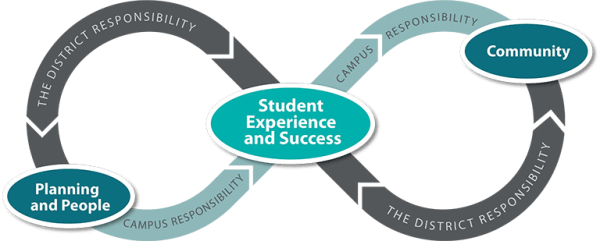
The primary responsibility of NOCCCD is to support Cypress College, Fullerton College, and NOCE in achieving their site-specific strategic plans while supporting all three sites and the district towards addressing the strategic initiatives outlined in the EFMP and the 2023 EFMP Refresh. The visual illustrates the desired relationship between the district and sites, including three categories of strategic initiatives: Student Experience and Success, Planning and People, and Community.
Measurement Plan
| First Semester | |
| Service Utilization Data | Develop systems to track student use of and access to programs and services |
| Matriculation Data | Monitor dual enrollment high school student pathways and review NOCCCD enrollment after dual enrollment participation |
| Employee Experience Survey | Evaluate: belonging, connection, and engagement; access to opportunity vs actual participation; professional development application |
| Collaboration | Variety of employee stakeholders in governance bodies, association, and workgroups |
| Second Semester | |
| Service Utilization Data | Review Data on student use and access to programs and services by demographics |
| Student Experience Survey | Evaluate: belonging, connection, and engagement; needs met based on service utilization |
| On-Track Data From 1st Semester | % of program requirements completed and % of student educational plans developed |
| Employee Experience Interviews | Evaluate: belonging, connection, and engagement; access to opportunity vs actual participation; professional development application |
| Collaboration | Variety of stakeholder participants; communication strong/improved |
At the end of year, metrics considered in the measurement plan will be:
- Course retention
- Course completion
- Fall-to-spring persistence
- Fall-to-fall persistence
- Degree/certificate completion
- Climate survey (employees)
- Employee exit interviews
- Employee collaboration in key decisions
NOCCCD District-wide Objectives
Corresponding Vision 2030 Goal — Goal 2: Equity in Success
Supports equitable outcomes and achievement through care, compassion and connection to:
- Enhance the student experience through DEIAA approaches
- Develop collaborative, autonomous learners
- Strengthen student support services
- Provide clear pathways to completion
- Use technology to offer flexible learning options
Input Measures (prioritize and support innovation)
- DEIAA approaches implemented (curricular audit, prof learning, process reviews)
- Enhanced instructional approaches
- Evaluate, enhance, and expand
- Ed plan development
- Tech infrastructure to support flexibility and innovation
Process Measures
- Belonging/connection/engagement
- Measures of aspiration/hope/goal
- Use of student services and measure of needs being met
- Measures of “on-track” to completion
- Disaggregate measures (range of groups)
Outcomes
- Course Retention
- Course Completion
- Degree/Certificate Completion
- Transfers/Transfer Degree
- Disaggregate Measures (range of groups)
Corresponding Vision 2030 Goals — Goal 1: Equity in Access & Goal 2: Equity in Support
Facilitate inclusive partnerships, expand access to programs and services, encourage collaboration, and prioritize DEIAA, supporting:
- Academic and career goals
- Basic needs
- Success through seamless pathways within/beyond our institutions
Input Measures (prioritize and support innovation)
- Strengthen and expand partnerships (businesses/community)
- Create the space and support for cross-collaboration (internal and external)
- DEIAA focus across all partnerships and collaborations
Process Measures
- Increased matriculation from high school pathway programs
- Cross-collaboration in action (opportunity to participate)
- Belonging, connection, and engagement
- Diverse needs being met
- Professional development applied (6 weeks later)
Outcomes
- Enrollment
- Apprenticeships/internships
- Course Completion
- Persistence
- Climate Survey (Employee)
Corresponding Vision 2030 Goals 1 through 3
Promote resource stewardship, employee development, inclusive decision making, and campus accessibility/sustainability to:
- Foster a positive experience/support employee development
- Strengthen participatory governance with a DEIAA emphasis
- Improve campus physical space to enhance student and employee well-being
- Align resources through integrated planning
Input Measures (prioritize and support innovation)
- Support professional development, engagement, and community building (connection)
- Create opportunities for better communication & shared leadership; include employee voice in decisions
- Facility improvements and sustainability projects
- Align resources to goals and support innovation
Process Measures
- Employee satisfaction measures
- Diverse (lived experience) participants
- Improved communication
- Increased and/or enhanced use of sustainable physical space and technology
- Resources aligned to goals, innovation to meet unique needs (campus resource requests tied to plans)
- Professional development applied (6 weeks later)
Outcomes
- Climate Survey (Employee)
- Employee Exit Interviews
- Employee/Student Wellbeing
- Goal Achievement through fiscal stewardship